| O Ce Biel |
| From the Friulan song "O Ce Biel Cjiscjel a Udin" |
| Memories of 1970s Friuli |

|
| HomeArrivalBrandoGowanTalmassonsTerremoto |
| ReturnFoodPoemsSongsVeniceTriesteUdineseMerlot |
Terremoto |
It was the evening of Thursday 6th May 1976, just before 9pm. I was teaching my English language class in the village of Talmassons (see the section of that name). The students were all from the village and surrounding hamlets, members of the Circolo Culturale who had organised the year-long event in the interests of broadening their horizons. It was an intensely hot evening for early May, dry and faintly oppressive, possibly more so because of Talmassons' position on the flat plain south of Udine running down to the sea at Lignano. Fortunately we were in one of the cool classrooms of the primary school, a solidly-built single-storey building on the edge of the village. We had started at 8pm and were just about to take a short break. Seconds after 9pm, I was standing with my back to the outside wall of the classroom, ready to take a breath of fresh air outside the school with the students. There was a loud rumbling behind me, outside, like a large truck reversing. A pause, then a much louder grinding roar, the walls screaming. The classroom shook from side to side, the floor moved; it was difficult to stand up. We all (well, not all, it turned out) ran for the classroom door, then turned left down the corridor to the main entrance, a distance of 30 metres. It was a broad corridor, but I remember being thrown from one wall to other. Outside, I swear the gravelled playground was rolling like a sea swell. Less than a minute and it was over, still again and very hot. We were all in a group, except for one member of the class. Federico Zanin, the railwayman, had not joined the panic-stricken exodus but stayed behind in the classroom, tidying books. He emerged quietly from the school, smiling ruefully. We talked animatedly in the courtyard, trying to establish what had happened. It had pretty clearly been an earthquake. What we didn't know was the extent. That became clear over the following days. Below is a map of Friuli. Talmassons is marked approximately by a red "T" and dot. Gemona del Friuli, the most affected town to the north, is indicated with another red dot. 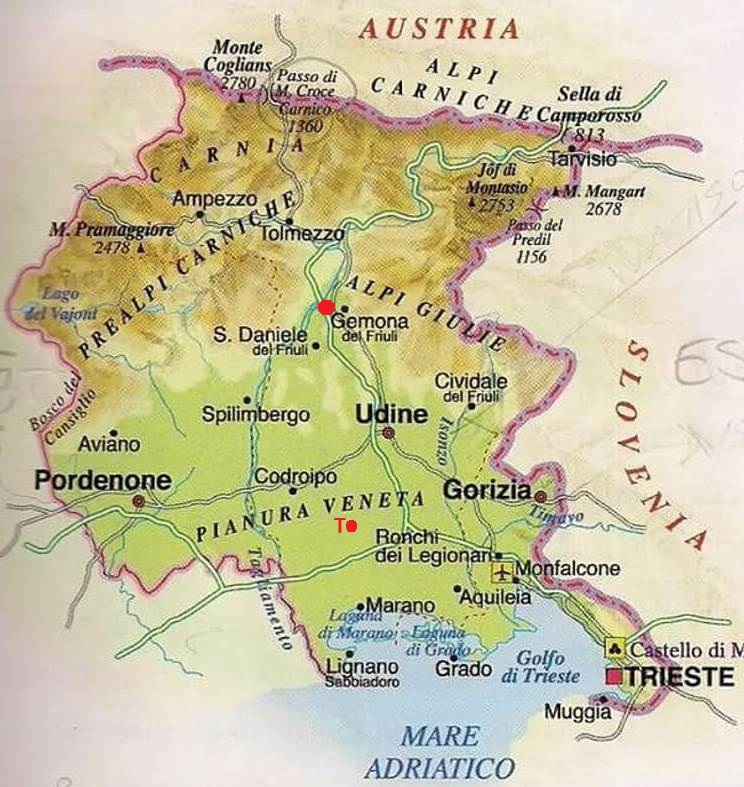 The first quake on 6th May was measured 6.5 on the Richter scale. This was followed by at least two more significant tremor ("scossa") groups on 11th September (5.8 at 18:31, 5.6 at 18:40) and 15th September (5.9 at 05:00, 6.0 at 11:30). The epicentres are circled 1, 2 and 3 in the darkest red shaded area. 989 people died. Gemona had the largest number of fatalities at 325. 2,607 were injured. People were re-housed in "prefabbricati", temporary homes. The percentages of the population for certain towns or villages in such dwellings are listed at the bottom. The numbers are from March 1978, nearly two years after the event. The biggest proportion was in Lusevera, at 95.3%, albeit on total inhabitants of about 600. Immediately after the 6th May quake, the US military from the airbase at Aviano near Pordenone built tent villages on the flat farmland to the west of the hill towns. We visited one near Gemona at Trasaghis - more of this later. The coastal resorts to the south took in many of the displaced ("sfollati"). Lignano took 19,076, Grado 6,299, Bibione 4,566. A total of 32,276 left the region at least temporarily. The most severely damaged areas, designated "disastrati", were logically near the epicentres north of Udine. Talmassons, 20 kilometres south-west of Udine, 58 kilometres south of Gemona, was barely affected. In the moments after the quake, I therefore had no understanding of the mayhem further north. I drove back to Udine. At around 11pm, the city was busy as I entered. Nobody had any inclination to be indoors, certainly not to sleep. Portions of the inner ring road with grass dividing strips already had tents erected. I went to bar Da Brando, where as expected I met several other teachers from the Oxford School. I have no idea when we went to bed that night. The Oxford School, in Via Paolo Sarpi in the historic centre of Udine, had sustained some damage and was closed for a period. We therefore had time on our hands. Sue had a bizarre windfall. She found a 1,000 deutsche mark note in an Udine gutter. Generously, she decided to put this money to the cause. She hired a van and we were able to go up to the earthquake zone to do what we could to help. We didn't have many useful skills. We just drove up to see what we could do. I remember going to the tent city in Trasaghis days after the 6th May quake. Row upon row of tents, one to each family, in torrential rain. One family needed help retrieving possessions from their house in Gemona. We went up there, watched as they scrabbled in the ruins and brought back any useful and intact items. When we returned, the black-clad "nonna" was cooking in the tent on a camping stove and insisted that we should eat with them. In the midst of extreme loss, they still wanted to give through the sharing of food. Majano, where 119 perished, and which we visited one hot day following 6th May, was a scene of dust and destruction. Near the centre was a recently-built small block of flats, once six stories high. It had collapsed straight down on itself, a minor version of the 9/11 twin towers. The build quality of the flats was questioned. A grim dark joke was doing the rounds, an argument about responsibility between Bricks, Timber and Mortar. After much to-ing and fro-ing, Mortar declared: "It couldn't have been me - I wasn't there." Survivors were still presumed trapped. We heard that some standing on the upper balconies had simply descended to ground level and walked away. Helpers of all description (the Visualoop data map has a breakdown of national and international assisting groups, "reparti italiani" and "reparti stranieri") swarmed over the debris, removing rubble by hand. It was the only time I witnessed the dead. A soldier uncovered a body under the masonry, an arm reaching up to the sky. Our friend Ermanno in Talmassons had a brother, Angelo, who was a priest in Artegna just south of Gemona. A tall dark man with the most delightful open face, animated in expression and gesture. He and other members of the local clergy were central to the recovery process, not only in giving emotional help to parishioners, but also in keeping a strict eye on the deployment of support funds. Returning to England in the late summer of 1976, I gave some talks to raise money at schools in my home-town Worcester. The proceeds were handed over to Angelo; I was sure that they would be used effectively. We went up to Artegna with the Talmassons villagers most Sundays through that spring and early summer. Starting the day in a makeshift bar off the main square, it was the earliest I'd ever drunk alcohol. We were all given an expresso coffee accompanied by a shot of grappa. A "heart-starter" as the actor Oliver Reed called it. What did it all look and feel like? If you went back to places you had known before the earthquake, you could usually orient yourself by the street layout that remained. But the old stone-built houses had gone or were severely disfigured. The fronts of the houses might have disappeared, exposing bedrooms complete with furniture. On hot days the air was thick with dust, which had a strange stuffy odour, not quite decay, but close. After rain, the streets were awash with mud. Below is a picture of Buja, near Artegna. 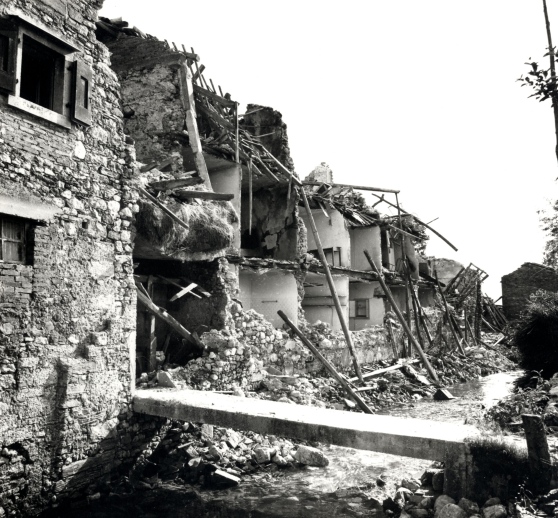
We met a couple called Gustin and Maria in Artegna, who lived on the main street running south from the main square. You entered the property through an arch, the house on the right, their land beyond, where Gustin's metal-working "capannone" was situated. The house was damaged, so they lived in a large hut set behind. Maria was a kind, radiant woman who always welcomed us with grace and generosity; in later years I took my parents, family and children to meet them. Gustin was a red-nosed Friulano countryman who loved his wine. After that night of 6th May, he never drank again. He said that he'd not realised before how little he'd done around the house to help Maria, but from then on assisted with shopping, cooking, cleaning. They had a little dog born on the night of the earthquake, so she was called Scossa ("tremor"), or Scossute in the Friulan diminutive. 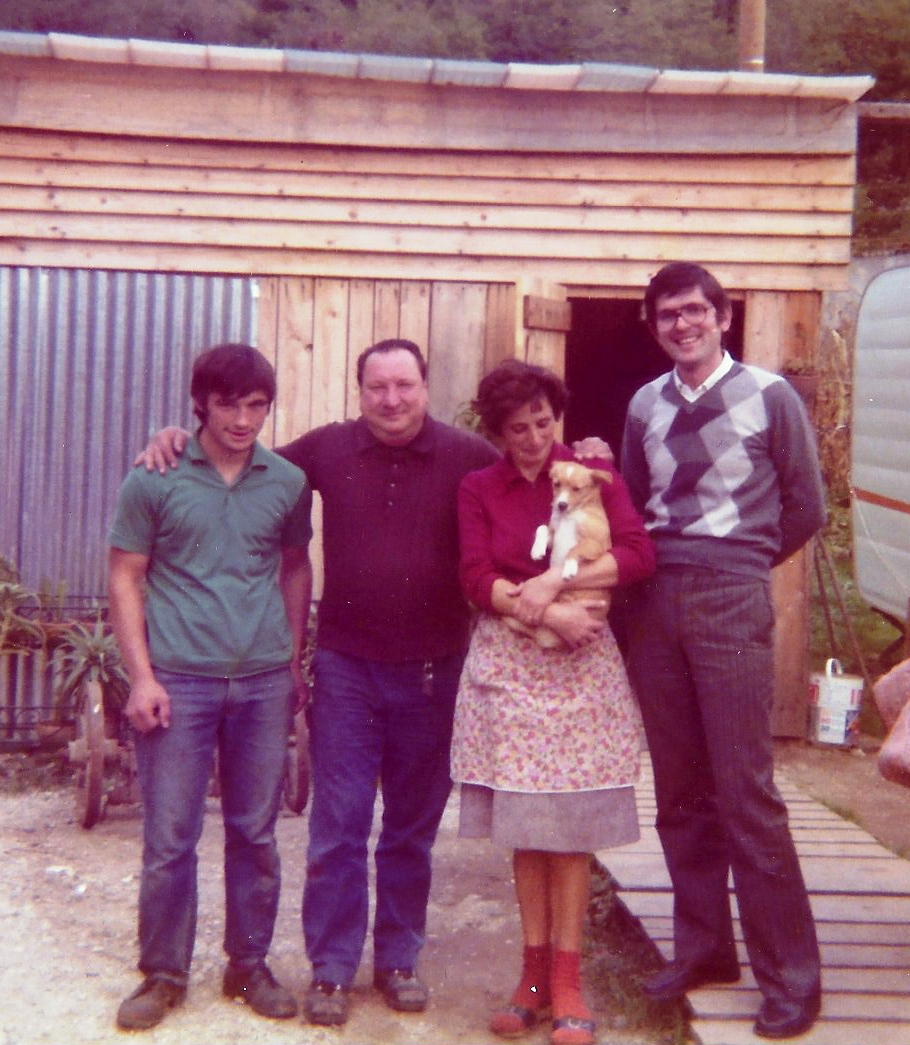
North-east of Artegna, further up into the mountains, the beginning of the Alpi Giulie, is a village called Montenars. We went there a couple of times. Again, we had no particular skills to offer, just our hands. We cleared the rubble from the local bakery. A significant character in the village was Don Francesco Placereani, or Pre Checo, a left-wing non-conformist priest. 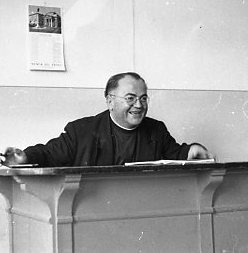
Born in Montenars in 1920, he died in Udine in 1986. He was an orator, writer, translator and Friulan activist. I stood next to him by the remains of his house. A wild, unkempt man was scouring the ruins, trying to rescue the library, which contained the priest's own writings, many of them original scripts. Pre Checo said to me, "I wish he'd stop. I'll just write some more." The picture below is of his temporary hut. From left to right, Giulio Zanin, Pre Checo, Charles, Federico Zanin and me, with bottiglione of red wine provided by Pre Checo. 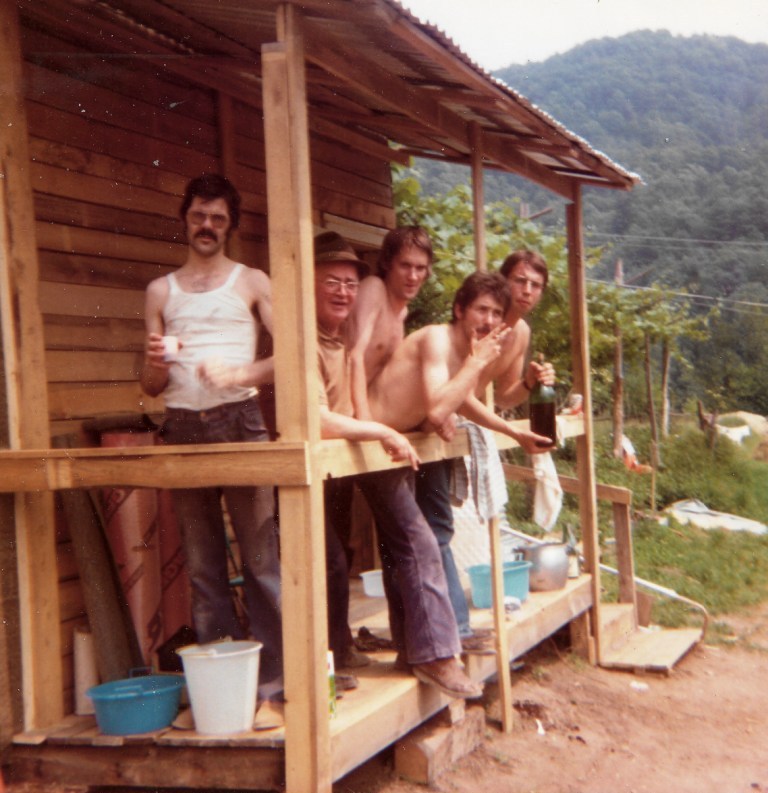 Notice the vines behind. The earthquake didn't kill them, nor the rest of the crops. The damage was all to man-made construction. The Friulan generosity in the face of adversity is a recurrent theme. We helped a farmer just outside Artegna, simple manual assistance. I took my parents to see him and his family some months later. On a trestle table in front of their damaged house, they laid out home-made salami, sheep's cheese and red wine. Why were they thanking us in this way? Lucia Beltrame, daughter of Carletto from Talmassons, sent me an email on the 40th anniversary of 6th May thanking us for our contribution (see the end of the "Talmassons" section). What contribution, such meagre help? I believe it was thanks just for our presence, being witnesses to their strife, taking an interest. Not much, but important to them. What of recovery? The management of restoration in the region is viewed as a success, unlike many such ventures that fell prey to corruption and waste. Below is an aerial photo of Artegna in recent times. 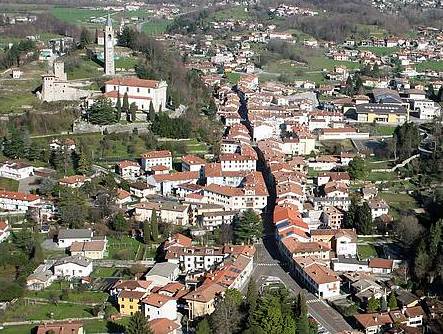 6 May 2026 - 50th anniversary On 5th May 2026 I arrived at Trieste airport in the evening and was collected by my friend of 50 years, Carlo Beltrame. He took me back to his home in the village of Talmassons (marked on the map at the top of this account with a red T and dot), where I had been teaching that night. The next morning I borrowed his car and took off for the zona terremotata to the north. A quicker journey these days. In 1976 I would have driven into Udine, round the inner ring-road to Piazzale Osoppo and then up the old strada statale SS13. Today, before you get to Udine there is a turn onto the tangenziale ovest - the western bypass - which leads to the autostrada that would take you all the way into Austria. A completely new experience for me. Signs to the hospital and Stadio Friuli, home of the football team Udinese, which eerily prompted reminders of experiences past. A journey of 35 miles in roughly 50 minutes, to the northernmost point I intended to visit; I was going to work my way south through the area.  I arrived at the walled town of Venzone, of which I have a poster in my home office, a photo of one of the entrance arches. I was forced to navigate round the eastern side of the surrounding moat as vehicle access is now prohibited. I came to a barrier on the north side being moved by a woman to get her car through; she told me she was allowed to do so as she lived within the walls, but indicated a handy small car park that I could use. I walked down the street to the centre hugging the stone walls of the buildings to keep out of the rain.  All beautifully restored, and, from a brief impression, somewhat gentrified. I passed a high-end wine shop and a traditional osteria that did not seem to be aimed at locals, more at visitors. Indeed, there were few residents around, and I leap-frogged down the street with a large group of Austrian tourists who had disembarked earlier from a coach parked opposite where I had left Carlo's car. On my way back from the centre they had filled the aforementioned osteria. And there they were in the middle of town, in Piazza Municipio, having their picture taken - in the second photo, below an image I've found from late 1976.   I wondered if this were actually a "6 Maggio" tour, targeted at this special anniversary day. Earthquake tourism? I popped into a genuine local bar-restaurant in piazza. Women having coffee at heavy wood tables, workmen with what looked like aperitivi, a dining room at the rear laid out for pranzo. Messages of thanks were everywhere, in fact throughout Friuli. People from all over the world came to assist in 1976 and their efforts were truly appreciated. Here's a blackboard I saw ...  ... and a sign above a shop door ...  The message was the same everywhere: "Friuli thanks and doesn't forget." Next stop Gemona, 6 miles directly south, even more than Venzone tucked right under the mountain - Monte Chiampon. I wanted to get to the Duomo di Santa Maria Assunta, probably the most famous landmark associated with the terremoto. Here's a photo taken in May 1976:  Driving round Gemona is very difficult at the best of times as the streets are steep, pass through tunnels, really not built for cars; indeed, it's much better to walk, but my back was painful and it was pouring with rain. Also, the police were closing off the centre in readiness for the afternoon visit of President of the Republic Sergio Mattarella and Prime Minister Georgia Meloni. Still, by some miracle I managed to get within 150 yards of the duomo and found a parking spot. There was hardly anybody about, except for a couple of policemen in front of the tourist office, and one small bar that hosted most of those residents who were in town that day. I reached the duomo and took this photo in persistent rain. As you can see, it is perfectly rebuilt.  Later in the day, back at Carlo's house in Talmassons, I watched on television the speeches given by Mattarella and Meloni. The latter praised the fortitude, pride and honesty of the Friulani in confronting the disaster. They took control of the finances and avoided much of the corruption that had occurred elsewhere. The reconstruction process acquired the name "Il Modello Friulano". I attach here an extract from Meloni's speech, for those who can understand Italian. You can see why people follow her: soulful eyes, deepish voice, poise, fluency, slightly louche, as if she's come in late from a night out, smoked too many fags. I'm used to the Friulan accent, which is quite sharp and sing-song; hers is a classic Roman drawl. If you know Italian, you may notice that she uses the passo remoto past tense, which I never really learnt as it's used less frequently in spoken language in the north, where the passato prossimo is more usually heard. Those wearing sashes of office are sindaci - mayors - of Friulan towns. I would like to note at this point that although Italy's President and Prime Minister made their pilgrimage to Gemona on this significant day, I was there before them and had travelled further. Next to Artegna, a 3-mile hop further south. On arrival the rain was torrential, so I drove up the hillside to the village of Montenars, where we had spent time later in May 1976. There's a picture of us further up this account stripped for the unseasonable heat, standing on the front porch of a wooden shack. Of the five of us in that picture, two are now dead - Pre Checo the priest, and Frederico Zanin. A third, Federico's cousin Giulio Zanin, now retired from his family bakery business in Talmassons, is unwell with cancer. Federico was one of the people I had been hoping to see on my visit. It brought home the passage of time; he was a young man when I last saw him, as was I. I sheltered from the rain under the roof of an elaborate war memorial. Not only did the village suffer the destruction of the earthquake, but it had lost many souls in both world wars, from a population of only 1,300 at the time of WWII. As Carlo said to me, the region has experienced more than its fair share of invasion, disaster and hardship. If you look closely at the memorial, you can see that many families lost several members.  Back down in Artegna, I parked near the central bar and went in for a coffee. As always I kept a receipt as a record:  Once again, a little further up this page there's a group photo of four people. The two in the middle, as already described above, are Gustin and Maria. I explained to the landlady behind the bar - the receipt shows her name, Alessia Gardel, hence Bar Gardel - that I had been there 50 years ago, and wondered if Gustin and Maria were still living down the street. She said that Gustin had died two years previously, but that Maria was still alive. She picked up the 'phone and spoke to Maria's daughter Nelli, who lives in one of the apartments in the same building. They had rebuilt the old house completely into 6 apartments, one for Gustin and Maria, one for Nelli and her family, and the rest were let out. Nelli shortly arrived in the bar to big hugs. I hadn't seen her since 1976. She is now, like me, in her seventies. She took me down the street to their house, up to the first floor, and there was Maria. Now 93, frail, not leaving her house these days, but still bright as ever. We had a lovely chat for half-an-hour and I heard all about the children and grand-children. Here we are:  Nelli and I exchanged mobile numbers for WhatsApp, and she has since sent me a video made by the people and commune of Artegna to tell the story of the earthquake. A grandmother shares her experience of the terremoto with her grandson. The latter is played by Nelli's grandson Ermanno, Maria's great-grandson. The grandmother speaks Friulan, but there are subtitles in Italian. If you understand neither, the photography tells its own story. It's 10 minutes long. You can enlarge to full-screen with the  control icon. control icon.
I drove back to Talmassons along the roads I might have taken in 1976, down the SS13, right through the centre of Udine, out on the coast road to Lignano past the terrible - but cheap - flat in Via Pozzuolo. 50 years ago there was already considerable commercial and industrial development along the main roads; now there is, inevitably, much more. At dinner with Carlo, I said that I'd like to be on the steps of the school where I'd been teaching, at 9pm. We drove down through the village shortly before. The school is now the municipio, or town hall. As we arrived, a group of councillors came out, including the sindaco with his sash of office. He invited us to stand on the steps with them. The church bells rang at 9pm, as they did all over Friuli. We stood in silence. Carlo took a photo, too dark to see the detail - but we were there. I'm on the right.  |